
After completion of the 28-month program, the PA will be able to perform tasks of health care management presently performed by the primary care providers. The PA will act in a professional manner, practice good interpersonal and communication skills, teach and counsel effectively, and organize and integrate appropriate patient data. The PA will also be sensitive to the effects of illness on the patient and family, and, at all times, demonstrate an awareness of situations that require collaboration.
Program Goals
Goal 1
Admit and retain qualified learners who complete medical education as a PA.
Throughout the University of Iowa's PA Program history, students have been heavily integrated into the Carver College of Medicine's medical education, taking the same courses and graded on the same scale as medical students. The success of this program is through attracting and admitting highly qualified applicants that will be able to handle the rigor of this type of teaching format.
Each year, interviews with approximately 120 applicants are conducted for the 25 seats available. Our data, along with our graduation and PANCE pass rates, indicate that we recruit highly qualified applicants.
| Class Enrolled | Ratio of App/Enroll | Cum GPA/Sem Hours | Sci GPA/Sem Hours | GREs Verb/Quant/Anal/Total | Hours HCE** | Hours Res*** |
|---|---|---|---|---|---|---|
| 2021-2022 | 31.0:1 | 3.79/134 | 3.75/77 | 158/158/4.4 | 3,004 | 938 |
| 2022-2023 | 26.6:1 | 3.79/153 | 3.79/87 | 159/159/4.6 | 4,388 | 342 |
| 2023-2024 | 26.8:1 | 3.85/127 | 3.80/71 | 156/157/4.6 | 2,438 | 453 |
| 2024-2025 | 44.0:1 | 3.78/143 | 3.79/79 | * | 4,586 | 308 |
| 2025-2026 | 58.1:1 | 3.77/147 | 3.72/83 | * | 3,721 | 816 |
| 5 Year Mean | 37.3:1 | 3.80/141 | 3.77/79 | 158/158/4.5 | 3,627 | 571 |
The range of the Science GPA for the five application cycles is 3.20 - 4.00.
* The PA Program removed the GRE requirement in the CASPA 2023-2024 application cycle.
** HCE = Healthcare Experience
** Res = Research
The PA Program works very hard at helping those admitted to the program to be successful and graduate. Our goal is to have an attrition rate less than the national average as indicated in the table below. This compares significantly better than the national average as reported from the most recent PAEA Program Report. This demonstrates that the program selects students that will perform well in this educational program.
Our program has an overall true attrition rate of 1.4% for the three classes listed below.
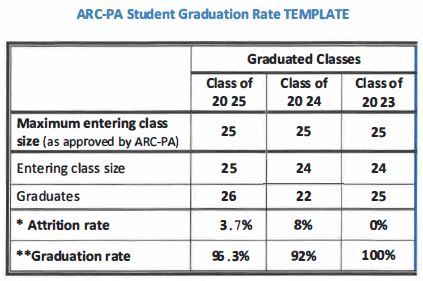
*Attrition rate calculation: Number of students who attritted from cohort divided by the entering class size.
**Graduation rate: Number of cohort graduates divided by the entering class size.
Goal 2
Provide an academic program that allows graduates to attain the essential knowledge for entry level practice as competent clinicians.
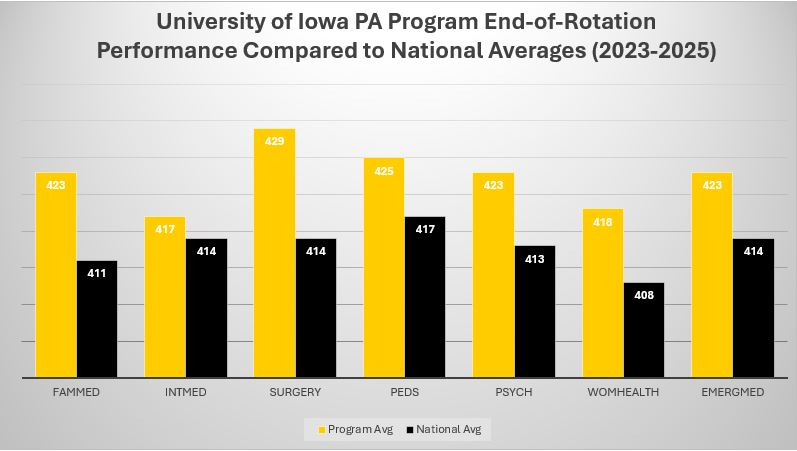
The University of Iowa PA Program has been heavily integrated within the Carver College of Medicine's medical education which provides essential knowledge and a strong emphasis on collaborative practice through its interprofessional education activities. This education provides the foundation for our students to successfully pass the End of Rotation (EOR) and End of Curriculum (EOC) examinations provided by the PA Education Association. Our goal is to be annually at or above the national averages for the EOR and EOC scores as demonstrated in the table below.
Goal 3
Educate students in rural or underserved communities.
The University of Iowa PA program has a long history of educating PAs to practice in all settings within healthcare. One area of emphasis has been to provide care to those in rural or underserved locations. To achieve this goal, the program places 100% of students in at least one rural or underserved setting, with the desire that this will foster an interest in this type of healthcare practice. As demonstrated in the table below, the program achieves their goal through both the strength of their didactic training (modeled in goal #2), and through placement in these settings (noted below).
Graduating | % with Underserved or Rural Clinical Rotations | % with Both Underserved or Rural Clinical Rotations | % with Rural Clinical Rotations | % with Underserved Clinical Rotations |
| 2021 | 100 | 83 | 87 | 96 |
| 2022 | 100 | 83 | 91 | 91 |
| 2023 | 100 | 92 | 92 | 100 |
| 2024 | 100 | 95 | 95 | 100 |
| 2025 | 100 | 100 | 100 | 100 |
Goal 4
Employ faculty and staff who lead in service and scholarship.
The University of Iowa PA Program fosters a culture of leadership by example of its faculty and staff. This goal is achieved and noted in the lengthy accomplishments of its faculty and staff.
National Leadership Organizations
- Vice Chair, Federal Advisory Committee on Training in Primary Care Medicine and Dentistry
- IOM Committee Member
- APAP President
- PAEA President
- Chair, ARC-PA Commission
- Journal PA Education Association, Editor
- Chair, Governance Committee, PAEA
- Chair, Clinical Education Committee, PAEA
- Chair, Data and Research, PAEA
- Conference Curriculum Committee, PAEA
- Research Institute, PAEA
- Leadership Development and Recruitment, PAEA
- Finance Committee, PAEA
- CASPA Liaison, PAEA
- NCCPA Liaison, PAEA
- Chair, Awards Committee, AAPA
- JAAPA Department Editor, AAPA
- Clinical and Health Affairs Commission, AAPA
- Education Council, AAPA
- Strategic Planning Committee, AAPA
- House of Delegates Representative, AAPA
State Organizations
- Iowa PA Society President
- Board of Physician Assistant Examiners for the State of Iowa
- Iowa PA Society Director at large
- Chair, Iowa PA Society Fall CME meeting
- Member, Iowa PA Society Fall CME meeting
Articles Published
- 121 in National Publications
- 66 in Book Chapters