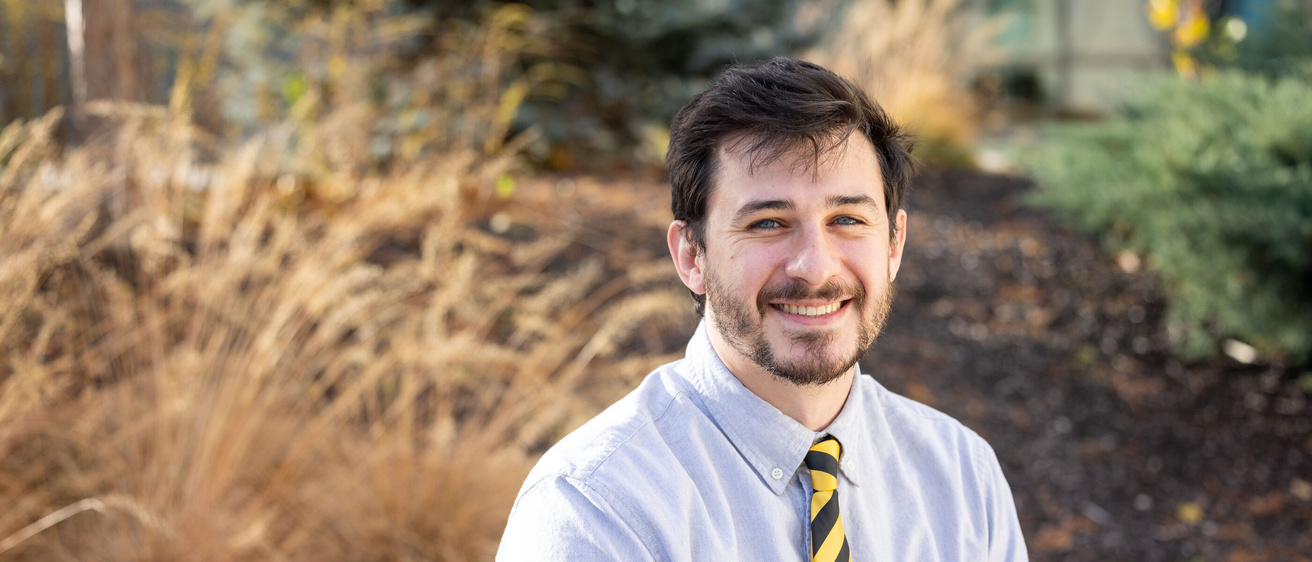
From Arvada, Colorado, to Iowa City, PA student Noah Vasquez has taken an unconventional and inspiring path into medicine.
In this Q&A, he reflects how a chance encounter in high school sparked his interest, how Iowa’s PA program exceeded expectations, and why the people he met here shaped his experience as much as the training itself.
What first inspired you to pursue a career as a PA?
My interest started in high school during a routine doctor’s visit. I ended up seeing a PA instead of my usual physician, and I was intrigued by the combination of patient care, critical thinking, and hands-on science. My dad has been an educator for more than 30 years, and I grew up helping in his classroom—so I’ve always loved teaching and science. Becoming a PA blended those interests perfectly.
I went on to study biomedical sciences at Northern Arizona University, minored in chemistry, and worked as a chemistry teaching assistant. After graduating during the height of COVID-19, I returned to Colorado and worked as a phlebotomist for three years. Those patient interactions and the problem-solving involved in clinical care solidified that becoming a PA was the right path.
What was it about Iowa onto your list—and ultimately into your life?
Honestly, I didn’t think I’d get into Iowa. It’s the number-one program in the country. But the application process was straightforward, making it more easily accessible.
When I got an invitation to interview, I reread the email several times because I didn’t believe it. My dad came with me to Iowa City, and during the interview I immediately sensed something different. The faculty were proud of the program but also humble and hungry to keep improving. That really resonated with me.
The interview questions ranged from ethical scenarios to one about an alien race rebuilding its civilization—it was unexpected, but it showed how broadly the program thinks. When I got the acceptance call from Tom O’Shea, I almost drove off the road. It felt unreal.
What stood out about your experience at the University of Iowa?
“Iowa Nice” is absolutely real. I’ve lived in Arizona, Montana, Colorado and Australia, and people are kind everywhere—but Iowa is something different. People here will give you the jacket off their back or invite you in if you need a place to stay.
As an out-of-state student, I felt welcomed immediately. My classmates are a huge part of that. I joke that I now have 25 siblings—everyone is supportive, extroverted, and truly invested in each other’s success. We celebrate birthdays together, study together, and lean on each other through tough moments.
Were there mentors or faculty who made a strong impression?
Absolutely. One who really impacted me is Marc Doobay, who runs our summer program. He created a series where faculty shared their personal journeys into the PA profession. Marc’s story resonated deeply with me—my dad is Hispanic and my mom is of English/Scottish descent, so growing up I often felt like I had a foot in two worlds. Marc shared a similar background, and that connection meant a lot.
He also happens to look a bit like my dad, so I had to resist treating him like family!
What was the academic experience like? Any special projects or involvement?
The program is rigorous, but collaborative. I enjoyed working with medical students and learning how our professions intersect. I also helped put together study review slides before exams and did some tutoring.
During my third semester, I was selected for the PAEA Future Educators Fellowship, which prepares students who may want to become PA educators. My project focused on how PA programs integrate ultrasound education—and how approaches vary based on program needs.
What are some of your favorite memories from your time at Iowa?
My class is very active. We played a lot of intramural volleyball through the Carver College of Medicine—although during a championship game I ended up tearing my ACL. One of my classmates had torn her ACL two weeks earlier, so we went through recovery together. My classmates rallied around me with advice, cards, and support.
We explored Lake MacBride, attended med school tailgates, went skiing, and even went scuba diving in Missouri with my girlfriend—also a PA—and a few friends. We made the most of our free time together.
I also enjoyed volunteering with Project Access, where we visited local schools to teach kids about what PAs do. Showing them ultrasounds of their own hearts or how to splint a wrist was a highlight.
What are your plans after graduation?
I’m planning to return to Arizona, where my girlfriend practices as a PA. I’m open-minded because I genuinely enjoy most areas of medicine, but I’m leaning toward outpatient work—urgent care, general medicine, procedures, pediatrics, or surgery. I like having variety and working with patients in acute but manageable settings.
What advice do you have for students considering the PA profession?
For applicants:
- Get as much exposure as possible. Shadow PAs, talk to people in different specialties, and fully explore the profession.
- Every state and practice looks different, so learn broadly.
- Build your experience and keep applying—I applied twice before getting in. Persistence matters.
For students who’ve already been accepted:
- Don’t study before the program starts. Truly—enjoy your time off. Travel, spend time with people you love, and rest.
- Iowa will prepare you. You’ll learn what you need, when you need it. I spent the summer before PA school in Indonesia, and I wouldn’t trade that break for anything.
How has becoming a PA changed you?
This experience has shaped not just how I think clinically, but how I see the world. Medicine exposes you to people from every background, and it challenges biases you didn’t even realize you had. It’s opened my eyes to the complexity and humanity of every patient. It’s the kind of growth I hoped for—and more.