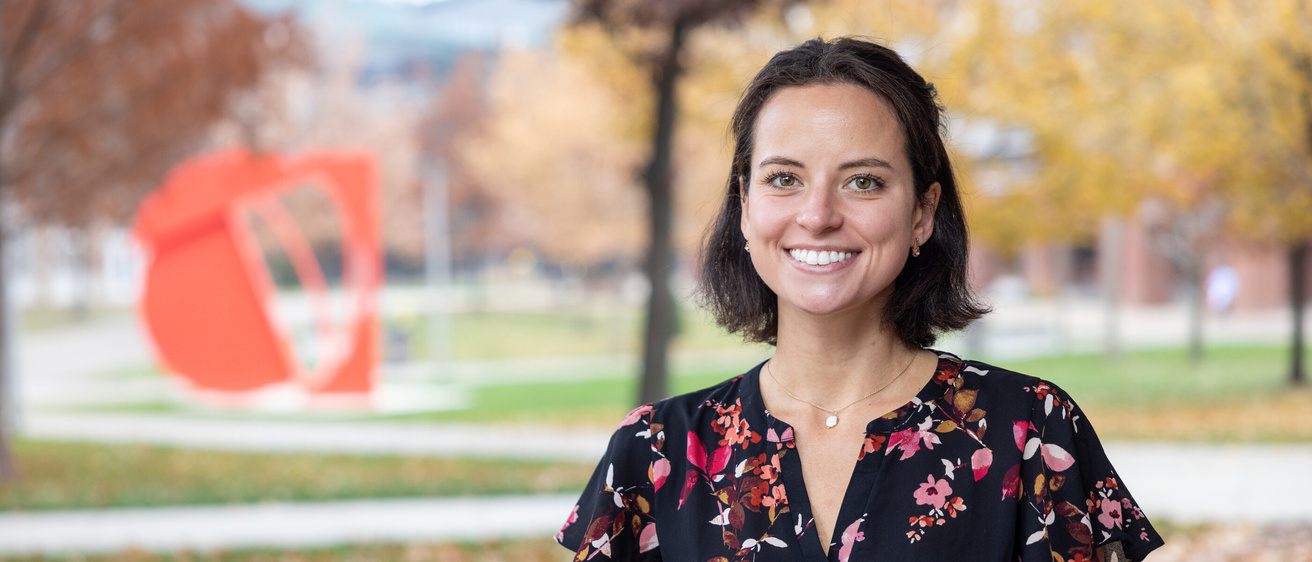
For PA student Clare Dunne, the path to graduation included more than lectures, labs, and clinical rotations—it included surviving brain cancer, stepping away from school for a year, and returning stronger than ever.
A Coralville native and Wartburg College graduate, Clare reflects on how family, faculty, and classmates shaped her journey, and how her experience as a patient has inspired her future in oncology.
What led you to pursue a career as a PA?
I’ve always felt drawn to health care. Both my parents are dentists, and from a young age I admired the relationships they had with their patients. We’d run into patients at the grocery store who clearly trusted and appreciated them—that stuck with me.
I initially went to Wartburg on a pre-med track, but my roommate was planning to become a PA, and she introduced me to the profession. I loved the idea of close patient interaction, working collaboratively with physicians, and being part of interdisciplinary teams. It felt like the right fit for the kind of clinician I wanted to be.
What made you choose the University of Iowa CCOM for PA school?
Iowa is close to home, and that’s always been important to me. But the biggest draw was the program’s exceptional reputation. If it weren’t such a stellar program, I probably would have been more tempted to go out of state, especially after spending so much time close to home during COVID. But I couldn’t pass up the opportunity to train at the University of Iowa, and I’m so grateful I made that decision.
What people or experiences have shaped your PA journey the most?
So many people have had an impact, but the defining event of my experience happened at the end of my didactic year. Right after finishing my final exam, I became extremely sick—headaches, vomiting, strange neurologic symptoms. We learned I had a 4x4 cm medulloblastoma brain tumor. I needed emergent neurosurgery and had to step away from school for a year for radiation and chemotherapy.
That year—and the support I received throughout it—shaped everything.
How are you doing now?
I’m doing well. I’m in remission and incredibly grateful.
How did the program support you during your diagnosis and treatment?
I truly wouldn’t be here without their support. When I was in the hospital, my mom called Carol Gorney, who leads our clinical education team, and within a day she and Jeremy Nelson were at my bedside telling me not to worry—that they would take care of everything.
The faculty checked in constantly. They kept my information private until I was ready to share, and they let me decide exactly what I wanted disclosed to my classmates. Carol gave me her personal phone number and stayed in touch throughout my entire treatment.
When it was time to return, she offered me the chance to audit the fall didactic semester so I could ease back in without the pressure of graded exams. The class below mine welcomed me with open arms. That transition could have been incredibly difficult, especially with my physical recovery and visible changes like losing my hair, but they made it feel natural and safe.
Iowa’s PA program didn’t just support me academically—it supported me as a whole person.
What are some of your fondest memories from PA school?
My “OG class,” as I call them, will always hold a special place in my heart. My best friend and roommate, Reagan, and our friend Olivia were part of so many late-night study sessions and long walks home from campus. Those daily routines—walking, talking through stress, supporting each other—became some of my favorite memories.
Our group went to Hawkeye games together and tailgated with my family, who loved meeting everyone. My best friend Reagan is getting married now, and it’s so special to celebrate these life moments with people who went through so much alongside me.
What advice would you give to incoming PA students?
- Invest in your classmates. These will be some of your closest lifelong friendships.
- Take it one step at a time. PA school can be intense, and in my case unpredictable. But uncertainty teaches you resilience.
- Learn the material with future patients in mind. Everything truly comes together once you reach clinical rotations.
- Have fun when you can. The work is rigorous, but the relationships and moments in between matter just as much.
How has being a patient shaped the way you care for patients now?
It’s changed everything. I recently worked with a patient at MD Anderson who had just learned their cancer diagnosis. Sitting in that room, I could feel exactly what each person in that family was experiencing—the fear, the waiting, the uncertainty. I’ve been in that hospital bed. I’ve watched my family react to hard news. I’ve waited anxiously for MRI results.
That perspective allows me to meet patients with deeper empathy. When families sense that you truly understand their fear and pain, it makes a huge difference. Those moments of connection are why I want to work in oncology.
What’s next for you after graduation?
I’m currently at MD Anderson in Houston completing a rotation—a dream I had even before my diagnosis. It has strengthened my desire to pursue oncology. I’m applying for oncology positions and exploring opportunities at places like Mayo Clinic, MD Anderson, and other cancer centers. I’m also considering oncology-focused residencies.
Is there anything else you want people to know about your journey?
The biggest thing is gratitude. My family, my classmates, my friends, and the faculty supported me in ways I can’t fully describe. I truly believe I was meant to be here at Iowa. I received incredible neurosurgical care, compassionate providers, and a program that refused to let me give up—even when I doubted myself.
Because of them, I’m graduating. I’m healthy. And I’m ready to give patients the same level of care and compassion I received.